
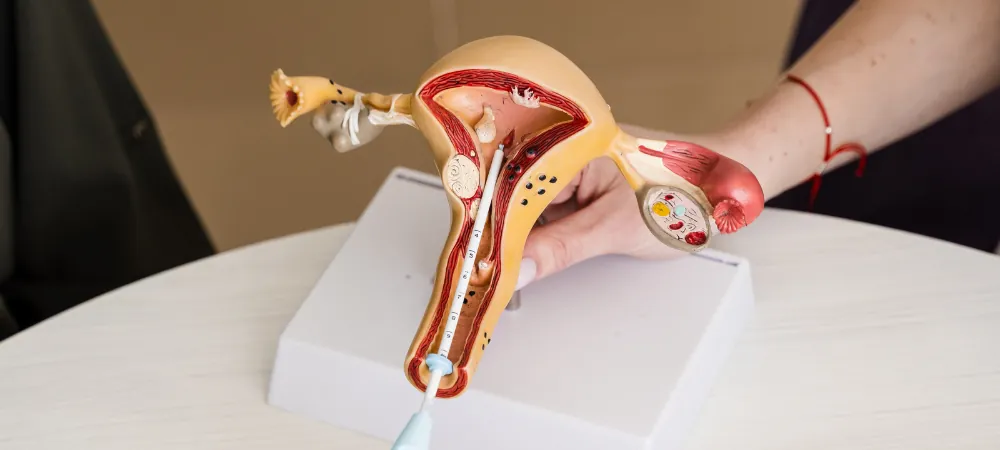
“You have a cyst on your ovary.” Hearing this after an ultrasound worries many women. Yet in the great majority of cases, it is a benign structure linked to the normal working of the ovary, and it disappears on its own within a few weeks.
Some cysts do need monitoring or treatment, however, and a few rare situations require urgent care. This article helps you understand what an ovarian cyst is, the different types, the signs that should prompt a visit and the possible solutions.
What is an ovarian cyst?
An ovarian cyst is a sac, usually filled with fluid, that forms on or inside the ovary. Its size can range from a few millimetres to several centimetres.
It helps to know that each month the ovary produces small fluid filled sacs called follicles, one of which releases the egg at ovulation. It is therefore normal to see “small cysts” on an active ovary. Your doctor can tell the difference between these normal images and a true cyst.
The different types of cyst
Functional cysts
These are very common. They arise from the cycle itself: a follicle that has not ruptured and keeps growing, or a corpus luteum, the structure that forms after ovulation, which fills with fluid or blood. They are benign and usually go away on their own within one to three cycles.
Organic cysts
These do not depend on the cycle and do not go away on their own. They include:
- the dermoid cyst, benign, which contains various tissues such as fat or hair;
- the endometrioma, linked to endometriosis and often associated with painful periods;
- the cystadenoma, a benign cyst filled with clear or thick fluid.
More rarely, a lesion of the ovary may be suspicious. That is why its appearance on ultrasound is analysed carefully, and why some cysts are monitored or removed.
Polycystic ovaries
Despite the name, polycystic ovary syndrome does not involve true cysts but many small follicles that do not mature. It is a different situation that mainly affects ovulation.
Possible symptoms
Many cysts cause no symptoms and are found by chance. When they do, you may notice:
- pain or heaviness on one side of the lower abdomen;
- pain during intercourse;
- changes in your periods;
- a bloated feeling or needing to pass urine often if the cyst is large.
Signs that need urgent care
Two complications, rare but serious, require immediate care:
- ovarian torsion: the ovary twists on itself and its blood supply is reduced. It causes sudden, severe pain on one side of the abdomen, often with nausea or vomiting;
- rupture or bleeding of a cyst: sudden pain, sometimes with feeling faint.
Sudden pelvic pain, fever with pain, or feeling faint should lead you to the emergency department. Likewise, if your period is late and you have pain on one side, an ectopic pregnancy must be ruled out.
How the diagnosis is made
A pelvic ultrasound (page in French), especially transvaginal, is the central test. It shows the size of the cyst, its contents, the thickness of its wall and any internal divisions or solid areas. These features point to a functional or organic cyst.
Depending on the case, your doctor may suggest a follow-up scan after your next period, an MRI to characterise the cyst further, or a blood test.
Monitor or treat?
A cyst that looks functional and causes no troublesome symptoms is usually just monitored: a new ultrasound after one to three cycles confirms that it has gone.
Surgery may be offered when the cyst persists, grows, causes pain, looks unclear or in case of complications. The operation is usually done by laparoscopy through small incisions, removing the cyst while preserving as much of the ovary as possible, which is essential for a young woman who wants children.
Ovarian cysts and fertility
Functional cysts have no lasting effect on fertility. Endometriomas and repeated ovarian surgery, however, can reduce ovarian reserve. When there is a pregnancy plan, the approach should be designed with fertility in mind. If you are trying to conceive, mention it at the first consultation.
Seeing a specialist in Fes for an ovarian cyst
A cyst found on ultrasound, pain on one side of your abdomen or questions about your fertility? A consultation helps interpret the image, decide whether to monitor or treat, and reassure you when possible. Our article when to see a gynecologist offers more guidance.
At Boudra Fertility Center, an IVF center in Fes, Dr Najib Boudra, a gynecologist with more than 30 years of experience, sees you in a gynecology consultation with ultrasound on site. Book an appointment on 05 35 93 08 18.
Book an appointment in Fes
A question, a first appointment? The Boudra Fertility Center team is here to help.
Boudra Fertility Center, 7 Rue Abdelkrim El Khattabi, 30000 Fes, Morocco
Frequently asked questions
Is an ovarian cyst dangerous?
In the great majority of cases, no. Functional cysts are benign and go away on their own. Some cysts need monitoring or removal depending on how they look.
Can a cyst go away on its own?
Yes, functional cysts usually disappear within one to three cycles. A follow-up ultrasound confirms it.
Does a cyst prevent pregnancy?
Functional cysts do not prevent pregnancy. Endometriomas, however, can affect fertility and need specialist advice.
When should I go to the emergency department?
If you have sudden, severe lower abdominal pain, especially with nausea, vomiting, fever or feeling faint.
This article is for information only and does not replace a consultation. For any question about your situation, talk to your doctor.