
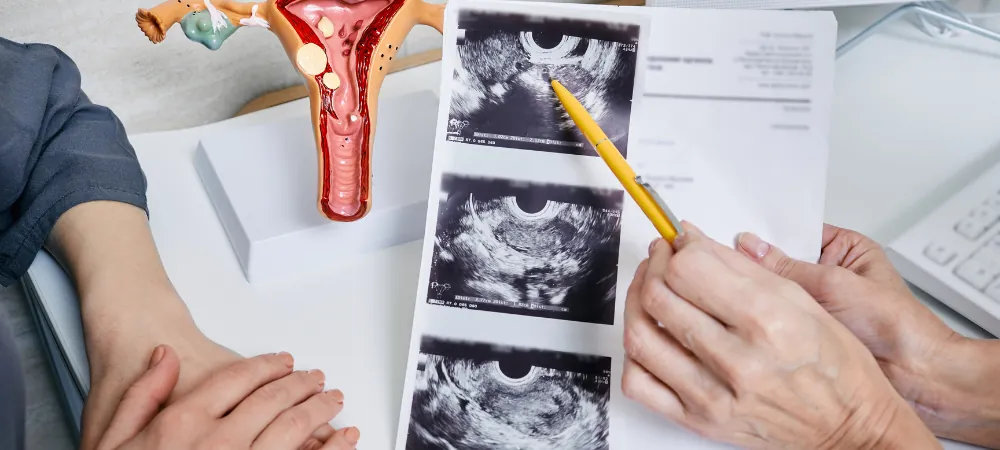
Normally, the embryo implants inside the cavity of the uterus. In an ectopic pregnancy, it implants elsewhere, usually in a fallopian tube. This pregnancy cannot develop normally and it can cause internal bleeding if it is not treated in time.
Knowing the warning signs helps you seek care quickly. This article explains why an ectopic pregnancy happens, how it shows itself, how it is diagnosed and what treatments exist, as well as the outlook for a future pregnancy.
What is an ectopic pregnancy?
After fertilisation, which takes place in the tube, the egg should travel to the uterus within a few days to implant there. If this journey is slowed or blocked, the egg may implant in the tube itself. More rarely, it implants on the ovary, the cervix or in the abdomen.
The tube is not designed to hold a pregnancy. As it grows, the pregnancy can stretch and then rupture the tube, causing bleeding inside the abdomen. This is why early diagnosis is essential.
Risk factors
An ectopic pregnancy can happen to any woman, even without a risk factor. Some situations increase the risk, however:
- a previous ectopic pregnancy;
- a past genital infection, especially salpingitis, which can damage the tubes;
- previous surgery on the tubes or pelvis;
- endometriosis;
- smoking, which disturbs how the tubes work;
- pregnancy occurring with an IUD in place, which is rare but needs monitoring;
- fertility treatment, which calls for close monitoring in early pregnancy.
Warning signs
At first, an ectopic pregnancy may look like a normal one: a missed period, a positive test, tender breasts. The signs that should alert you are:
- pain in the lower abdomen, often on one side, which can be severe;
- abnormal vaginal bleeding, often light and dark, different from a period;
- shoulder tip pain, which can be a sign of internal bleeding;
- fainting, dizziness, paleness or feeling weak.
If you have severe pain, feel faint or have shoulder pain with a positive test, go to the emergency department without delay. In other cases, a prompt consultation is needed. Our article on when to see a gynecologist covers the main signs that call for an appointment.
How is it diagnosed?
Transvaginal ultrasound
It looks for a pregnancy sac inside the uterus. If the uterus is empty while the test is positive, the doctor looks for a mass near the ovaries or fluid in the abdomen. Our article on pregnancy ultrasounds explains the role of the first scan.
Beta-hCG blood test
This blood test measures the pregnancy hormone. In a normal pregnancy, its level rises quickly in the first days. A slow or irregular rise, together with an empty uterus, raises suspicion of an ectopic pregnancy. The test is often repeated 48 hours later.
Clinical examination
The gynecological examination looks for localised pain and assesses general condition. Sometimes the diagnosis is not certain at the first visit and close monitoring is needed.
Treatment options
The choice depends on the size of the pregnancy, the hormone level, whether there is internal bleeding and the wish for future pregnancy.
Monitoring
In some very early cases, with a low hormone level that falls on its own, the doctor may suggest simple monitoring with blood tests until the hormone disappears.
Medical treatment
A medicine called methotrexate can be injected to stop the pregnancy from developing. It avoids surgery but requires regular beta-hCG tests over several weeks and is only possible under certain conditions.
Surgery
It is usually done by laparoscopy, through small cuts in the abdomen. The surgeon removes the pregnancy and keeps the tube when possible, or removes the tube if it is too damaged. If there is internal bleeding, surgery is done as an emergency.
What about the next pregnancy?
An ectopic pregnancy is a physical and emotional ordeal. It is normal to feel sadness or worry, and it is important to talk about it with your doctor and those close to you.
Medically, many women go on to have a normal pregnancy, including with only one tube. In the next pregnancy, an early ultrasound is advised to check quickly that the embryo is inside the uterus. If both tubes are damaged or missing, IVF makes it possible to bypass the tubes. Our page on pregnancy follow-up (page in French) describes the care offered from the start.
See a gynecologist in Fes
Any pain or bleeding in early pregnancy deserves medical advice. Prompt care protects your health and your fertility.
At Boudra Fertility Center, an IVF center in Fes, Dr Najib Boudra, an obstetrician gynecologist with more than 30 years of experience, provides early pregnancy care, early ultrasound and support after an ectopic pregnancy. Visit our gynecology page or call 05 35 93 08 18 to book an appointment.
Book an appointment in Fes
A question, a first appointment? The Boudra Fertility Center team is here to help.
Boudra Fertility Center, 7 Rue Abdelkrim El Khattabi, 30000 Fes, Morocco
Frequently asked questions
Can an ectopic pregnancy continue normally?
No. The embryo cannot develop outside the uterus. The pregnancy must be treated to protect the woman’s health.
What are the first signs?
Pain in the lower abdomen, often on one side, and abnormal bleeding with a positive pregnancy test.
Can I get pregnant after an ectopic pregnancy?
Yes. Many women have a normal pregnancy afterwards, with an early ultrasound to check the embryo is in the right place.
Is surgery always needed?
No. Depending on the situation, monitoring or medical treatment may be enough. Surgery is needed in some cases, especially if there is internal bleeding.
This article is for information only and does not replace a consultation. For any question about your situation, talk to your doctor.